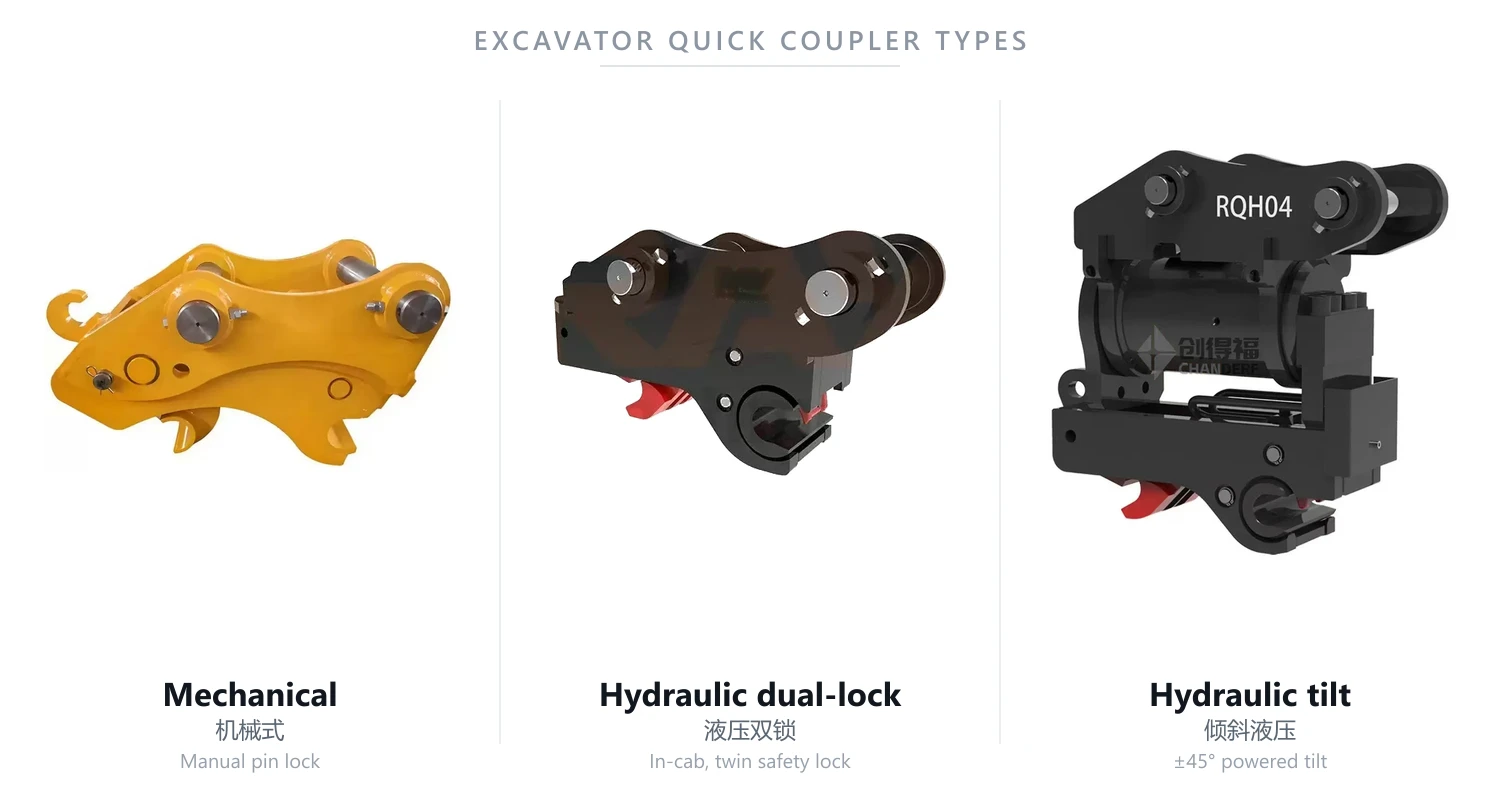
Swapping a bucket for a hammer on a standard pin-on excavator takes two people and half an hour. A quick coupler cuts that to one person and under a minute — or, with a hydraulic version, to a few seconds without leaving the cab. The right coupler can double the number of attachments a single machine can use in a day, which is why quick coupler retrofits are one of the most common upgrades buyers request before export. This guide walks through the three main types — mechanical, hydraulic dual-lock, and hydraulic tilt — so you can choose the right one before the machine ships.
Key takeaways
- Mechanical couplers are the entry-level option — faster than pin-on, but the operator must leave the cab to lock and unlock. Best for buyers on a tight budget who swap attachments infrequently.
- Hydraulic dual-lock couplers are the most popular retrofit — full attachment swap from the cab in under a minute, with two independent safety locks. The standard choice for rental fleets and multi-attachment worksites.
- Hydraulic tilt couplers add a lateral tilt axis — the attachment can angle ±45° left or right from the cab. Valuable for sloped trenching, grading, and any site where the ground isn't level.
- On a 20-ton machine (CAT 320 class), installed costs run approximately $1,200 for mechanical, $2,500 for hydraulic dual-lock, and $5,500–$6,500 for hydraulic tilt.
- Coupler type must match machine pin size — there is no universal standard; always specify your machine's pin diameter, pin center distance, and bucket class when ordering.
What is an excavator quick coupler?
A standard excavator attachment — bucket, hammer, grapple, thumb — is held to the arm by two steel pins running through the dipper tip and the attachment's pin boss. Removing and reinstalling those pins by hand typically takes 20–40 minutes and requires at least one person on the ground with a mallet and pin-punch. On a job where you need to switch between a bucket and a hydraulic hammer four times a day, that's two to three hours of lost productive time.
A quick coupler mounts permanently between the arm tip and the attachment. It captures the attachment's two pins inside the coupler body and uses a locking mechanism — either a manual wedge (mechanical) or a hydraulic cylinder (hydraulic) — to hold them securely. When you want to change attachments, you disengage the lock, back the coupler out of the attachment's pin eyes, position over the next attachment, and re-engage the lock. On a hydraulic coupler, this happens from the operator's seat.
Note on terminology: "Quick coupler," "quick hitch," and "quick attach" are used interchangeably across brands and markets. In the US, "quick coupler" is the more common term; "quick hitch" is prevalent in Europe and Australia. The devices are mechanically the same.
Type 1: Mechanical quick coupler
How it works
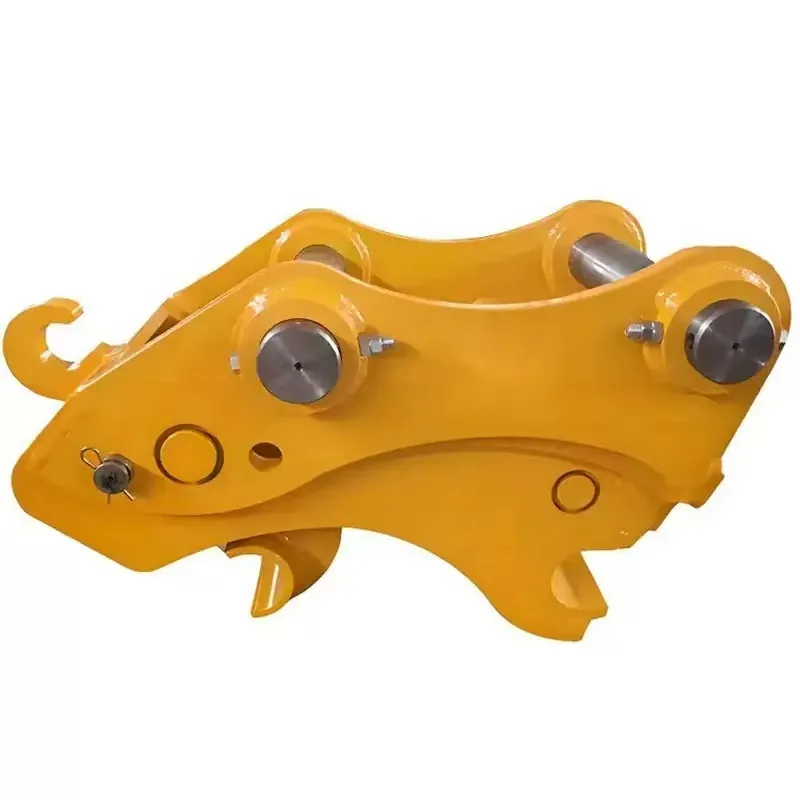
A mechanical quick coupler has a fixed front hook that captures the attachment's front pin, and a moveable rear jaw or wedge that swings or slides into position behind the rear pin. Once the rear jaw is engaged, the operator — standing on the ground — manually drives a locking pin or tightens a bolt to hold the jaw in place. To release, the process is reversed: loosen the lock, lift the jaw, and back the machine away.
Pros
- Lowest cost. On a 20-ton machine, a mechanical quick coupler runs around $1,200 installed — a fraction of hydraulic options.
- No auxiliary hydraulics required. The machine doesn't need a secondary hydraulic circuit, which matters on older or simpler machines that weren't plumbed for powered attachments.
- Simple and reliable. Fewer moving parts means fewer things to fail. A mechanical coupler has no solenoids, hoses, or cylinders to service.
- Still much faster than pin-on. Even with the manual lock step, swapping an attachment takes 5–10 minutes instead of 20–40.
Cons
- Operator must leave the cab every time. Locking and unlocking requires someone on the ground. In rain, mud, or confined sites, this is a significant productivity and safety issue.
- Risk of partial engagement. If the rear lock isn't fully engaged, the attachment can disengage under load — a serious safety hazard. Mechanical couplers depend entirely on the operator following the locking procedure correctly every time.
- No interlock with the machine. Some hydraulic couplers can be wired to prevent the operator from swinging or lifting with an unlocked coupler; mechanical units have no such failsafe.
Best for
Buyers who swap attachments infrequently (once or twice per week), are working in a controlled yard environment where stopping is easy, and want the lowest possible retrofit cost. Also a sensible choice if the machine's hydraulic system isn't set up for auxiliary circuits and you don't want to replumb it.
Type 2: Hydraulic dual-lock coupler
How it works
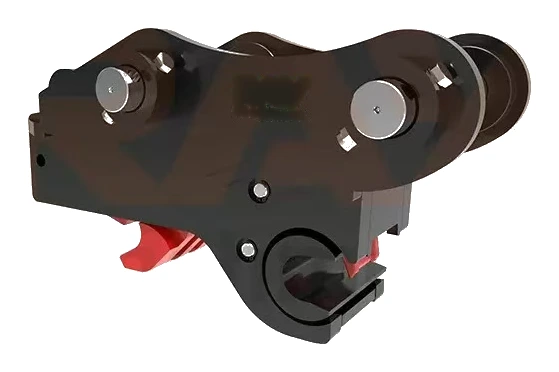
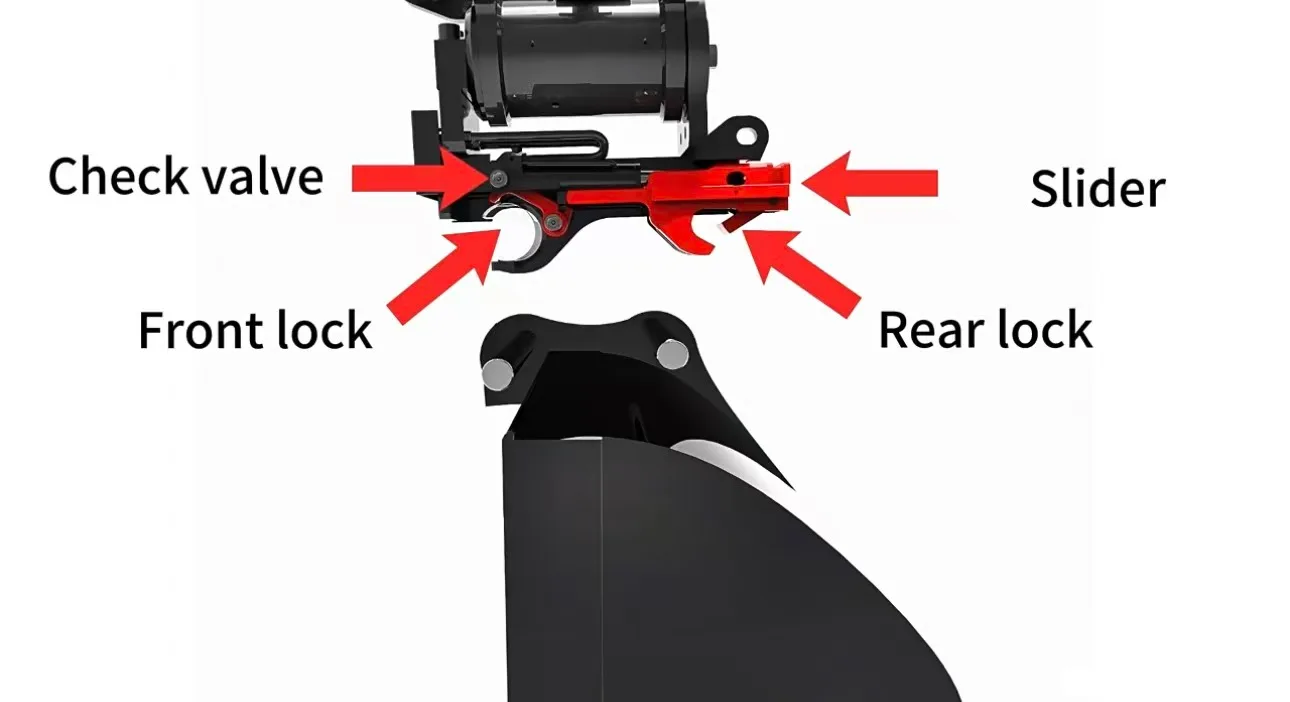
A hydraulic dual-lock coupler uses a hydraulic cylinder — fed from the machine's auxiliary circuit via a pair of hoses — to actuate the rear locking jaw. The operator engages and releases the lock from a switch or button in the cab. The "dual-lock" designation means the coupler has two independent locking pins: one pins the rear jaw mechanically after the hydraulic cylinder closes it, creating a secondary mechanical lock that holds even if hydraulic pressure is lost. This is the safety standard most modern hydraulic couplers meet, and is required by ISO 13031.
Pros
- Full cab control. Attachment swaps happen in under 60 seconds without the operator leaving the seat. On a multi-attachment day, this compounds into hours of recovered productive time.
- Two independent locks. The mechanical secondary pin means the attachment stays on even if hydraulic pressure drops — addressing the main safety concern with earlier single-lock hydraulic designs.
- Compatible with most attachments. As long as the attachment matches the coupler's pin class, any hydraulic or non-hydraulic attachment can be used — bucket, hammer, grapple, thumb, plate compactor.
- Reasonable retrofit cost. On a 20-ton machine, installed cost is around $2,500 — roughly double the mechanical option, but the productivity payback is fast on any site doing more than two attachment swaps per day.
Cons
- Requires auxiliary hydraulics. The machine needs a working auxiliary circuit (typically controlled by a thumb wheel or foot pedal) with enough flow and pressure to drive the coupler cylinder. Most modern excavators have this; older or stripped machines may not.
- More to service. Hoses, fittings, solenoids, and the locking cylinder all add maintenance points compared to a mechanical coupler.
- Adds some weight and length to the arm. The coupler body is typically 80–150 kg on a 20-ton machine, which slightly reduces maximum reach and rated lift capacity. Factor this in if your work is right at the machine's limits.
Best for
Rental fleets, contractors running multiple attachments daily, and any operation where stopping to lock a coupler manually would be disruptive or unsafe. The hydraulic dual-lock is the most common quick coupler type on used excavators we export — it's the sweet spot of cost, safety, and usability for most buyers.
Type 3: Hydraulic tilt coupler
How it works
A hydraulic tilt coupler adds a second hydraulic actuator to the coupler body — either a pair of tilt cylinders or a rotary vane unit — that lets the attachment tilt laterally — typically ±45° left and right — while the machine is stationary. Like a dual-lock coupler, it locks attachments from the cab and requires an auxiliary hydraulic circuit. The tilt function requires a second dedicated hydraulic circuit(or a proportional valve on the existing circuit), making the installation more involved than a standard hydraulic coupler.
It's worth distinguishing a tilt coupler from a tilt rotator. A tilt coupler only tilts — left and right. A tilt rotator adds full 360° continuous rotation on top of the tilt, which dramatically expands what a single machine can do but also costs far more — $25,000–$50,000+on a 20-ton machine for premium brands like Steelwrist, Engcon, or Rototilt, though Chinese-built units start closer to $8,000. If your work doesn't require rotation, a tilt coupler delivers most of the benefit at a fraction of the price.
Pros
- Works on slopes and uneven ground. The operator can tilt the bucket to follow the ground grade without repositioning the machine — essential for slope trimming, ditch shaping, and contour grading.
- Cleaner trench floors on angled cuts. In utility trenching work, the tilt function lets the bucket cut a precise angle on a slope without the machine having to track sideways.
- Reduces repositioning cycles. On confined sites, being able to angle an attachment saves the machine from repeatedly traveling to a new position — a real productivity gain in tight access work.
- Still cheaper than a tilt rotator. On a 20-ton machine, a hydraulic tilt coupler is around $5,500–$6,500 installed — a reference price that varies by brand and whether the machine already has the second hydraulic circuit.
Cons
- Higher cost. At roughly double the price of a hydraulic dual-lock coupler, it only makes sense if you regularly work on slopes or do precision grading work.
- More complex installation. A second hydraulic circuit needs to be either added or re-routed, which adds installation time and cost — especially on machines not originally plumbed for it.
- Not a tilt rotator. If your work requires rotating the attachment as well as tilting it, a tilt coupler won't be enough. The jump to a tilt rotator is expensive, but it's a different tool.
- Heavier than a standard coupler. The additional tilt cylinder and frame add weight compared to a dual-lock coupler, reducing effective reach and lift capacity slightly.
Best for
Contractors doing slope grading, ditch trimming, culvert work, and pipeline laying on uneven terrain. Also valuable on landscaping projects where precise bucket angle matters for finish quality. If your site is mostly flat and level, the premium isn't justified — a hydraulic dual-lock coupler will serve you better.
Side-by-side comparison
All installed cost figures are for a 20-ton excavator (CAT 320 class). Prices are reference values and vary by brand, machine condition, and whether auxiliary hydraulics need to be added.
| Feature | Mechanical | Hydraulic Dual-Lock | Hydraulic Tilt |
|---|---|---|---|
| Lock method | Manual — exit cab | From cab (hydraulic + mech pin) | From cab (hydraulic + mech pin) |
| Attachment swap time | 5–10 min | < 1 min | < 1 min |
| Lateral tilt | No | No | Yes (±45°) |
| Aux hydraulic circuit needed | No | Yes (1 circuit) | Yes (2 circuits) |
| Installed cost on 20t machine | ~$1,200 | ~$2,500 | ~$5,500–$6,500 |
| Best for | Budget buyers, infrequent swaps | Rental fleets, daily multi-attachment work | Slope work, grading, angled trenching |
Which type should you choose?
Choose mechanical if: you're on a tight budget, swap attachments less than once a week, and your site allows the operator to safely step off the machine. The $1,200 installed price is hard to beat for occasional-use scenarios.
Choose hydraulic dual-lock if: you run more than two attachments on the same machine in a normal working day, operate a rental fleet, or simply want the efficiency and safety of cab-controlled locking. At $2,500 on a 20-ton machine, the payback time in recovered labor is typically measured in weeks rather than months.
Choose hydraulic tilt if: a meaningful portion of your work happens on slopes, in ditches, or requires precise bucket angle control that repositioning the machine can't efficiently solve. If your site is flat, save the money and go dual-lock. If you eventually need full rotation as well, look at tilt rotators and budget accordingly.
Pin compatibility matters more than most buyers expect. Excavator attachments are manufactured to various pin standards — and not all are interchangeable. When ordering a coupler, you need to specify your machine's dipper pin diameter, the center-to-center distance between the two pins, and the attachment class. Buying a coupler without verifying these dimensions against your existing attachments is the most common retrofit mistake.
Getting a quick coupler installed before export
If you're sourcing a used excavator from China, the most cost-effective time to fit a quick coupler is before the machine ships. Installation at origin avoids the logistics of sourcing a coupler locally after delivery, and the labor cost in China is significantly lower than in most destination markets. We can source and install mechanical, hydraulic dual-lock, and hydraulic tilt couplers in-house, matched to your machine's pin dimensions, before export.
The same applies to other pre-export modifications— custom buckets, auxiliary hydraulic circuits, rubber track conversions, and paint — which can all be done at the same time to minimize downtime after delivery.
Browse our current used excavator inventory or visit ourused CAT excavator stock to see 20-ton class machines that are ready for quick coupler retrofit before shipping. If you have a specific machine and want a quote for coupler installation, get in touch and we'll confirm the compatible coupler spec and current lead time.
Frequently Asked Questions (FAQ)
What is an excavator quick coupler?
An excavator quick coupler (also called a quick hitch) is a device mounted between the excavator arm and any attachment — bucket, hammer, grapple, etc. — that lets the operator change attachments without manually removing and reinstalling the two steel pins that normally hold them. Mechanical couplers require getting out of the cab; hydraulic couplers lock and unlock from the operator's seat.
What is the difference between a mechanical and hydraulic quick coupler?
A mechanical quick coupler lets you swap attachments faster than a pin-on setup, but the operator still has to leave the cab to manually engage the safety lock. A hydraulic quick coupler uses a hydraulic cylinder to lock and unlock the attachment from inside the cab — attachment swaps take under a minute and the operator never has to touch the ground.
What is a hydraulic tilt coupler?
A hydraulic tilt coupler is a quick coupler that adds a hydraulic tilting axis — typically ±45° — so the operator can angle the attachment left or right from the cab. This is useful for sloped trenches, grading work, and any job where the ground isn't level. It is different from a tilt rotator, which adds full 360° rotation on top of the tilt.
How much does it cost to install a quick coupler on an excavator?
On a 20-ton excavator (CAT 320 class), a mechanical quick coupler runs around $1,200 installed. A hydraulic dual-lock coupler is around $2,500 installed. A hydraulic tilt coupler is typically $5,500–$6,500 installed, depending on brand and the complexity of the hydraulic circuit work required.
Is a quick coupler safe for excavators?
Modern hydraulic dual-lock couplers have two independent locking pins — if one fails, the other holds the attachment. Mechanical couplers are only as safe as the manual locking procedure: a partially engaged lock is a serious hazard. Always verify the lock visually before lifting or swinging an attached load, regardless of coupler type.
Can any excavator use a quick coupler?
Most excavators from 1.5 tons to 50+ tons can be fitted with a quick coupler. The coupler must be matched to the machine's pin dimensions and bucket class — a coupler sized for a 20-ton machine won't fit a 5-ton machine's pins. For hydraulic and tilt couplers, the machine also needs an auxiliary hydraulic circuit with sufficient flow and pressure.